





















 Six National Flags have flown over Bexar County, Texas: Spain.
1519-1685 and 1690-1821; France. 1685-1690; Mexico: 1821-1836; The
Republic of Texas: 1836-1845 Confederate: 1861-1865; and the United
States: 1845-1861 and 1865-Present. Texas was the 28th State in the
Union. San Antonio is the county seat of Bexar County since 1860.
Since that time, 128 counties have been formed from the original
Bexar County. Current population of Bexar County (2002) is
1,446,333.
Six National Flags have flown over Bexar County, Texas: Spain.
1519-1685 and 1690-1821; France. 1685-1690; Mexico: 1821-1836; The
Republic of Texas: 1836-1845 Confederate: 1861-1865; and the United
States: 1845-1861 and 1865-Present. Texas was the 28th State in the
Union. San Antonio is the county seat of Bexar County since 1860.
Since that time, 128 counties have been formed from the original
Bexar County. Current population of Bexar County (2002) is
1,446,333.
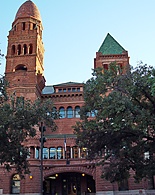
The Bexar County Courthouse is included in the National Register of Historic Places. It is the only major remaining Romanesque style structure in the San Antonio area. Bexar County's original courthouse (1731) was a one-story adobe structure (Casas Reales). The floors were dirt, the flagpole was a cactus, and there was a sundial over the door. The Casa Reales was the oldest capitol, and courthouse in Texas for over a hundred years. The greats of their day walked through the doors of Casas Reales, including Austin, Bowie, Houston, Ruiz, Santa Anna and the great JosŽ Antonio Navarro (1795 - 1871), one of the founders of Texas.
 The
bloody battles of Texas history came right to the Courthouse and the
Council House steps - and inside. The famous Court House Fight
(1840) began during a treaty signing and prisoner exchange with
Commanche Indians. In 1842, General Adrian Well crossed the Rio
Grande with Mexican troops and took possession of the district
court. As court was then in session, members became hostages while
court records were removed or destroyed.
The
bloody battles of Texas history came right to the Courthouse and the
Council House steps - and inside. The famous Court House Fight
(1840) began during a treaty signing and prisoner exchange with
Commanche Indians. In 1842, General Adrian Well crossed the Rio
Grande with Mexican troops and took possession of the district
court. As court was then in session, members became hostages while
court records were removed or destroyed.
The next courthouse, built in 1850 on Military Plaza, was two-stories high and included a jail. As the 2nd story became a roosting place for thousands of bats, it received the nickname of "Old Bat Cave." Court proceedings were begun with using two long poles and a crosspiece of timber against the canvas ceiling, to drive the bats out. Civil War vigilantes, the famous Belknap Rifles (named for Augustus Belknap, who helped form the company after admission to the San Antonio Rifles was refused), and Baptists also met in the "Bat Cave".
Bexar County has had a system of courts since the Texas Constitution was adopted (1836). In addition to 228 District Courts, there are six county courts at law, five Justice of the Peace Courts, the District Attorney, the County Clerk, and the District Clerk located in the Bexar County Courthouse today. The legal profession contributes greatly to the economy in Bexar County and San Antonio.
Bexar County's subtropical climate allows a growing season of about 265 days a year. San Antonio de Bexar began as an agricultural community. Major crops today are generally from the truck farms and include corn, hay, oats, sorghum, wheat, and fruits and vegetables.
Discovered by Europeans in 1691, (Domingo Teran de los Rios and Fray Damian Massanet) the villa of San Fernando de Bexar was the first city in the Spanish province of Texas. Epidemics and attacks by Apache and Comanche Indians devastated the Spanish Catholic missions, but the population showed remarkably fast recovery.
Bexar served as the capital of the province of Texas prior to statehood, though the area was predominantly Mexican at the beginning of the Texas Revolution. In 1844, San Antonio's population was 1,000, of which 9/10ths were of Mexican descent.
 In
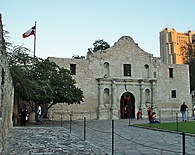
1835, resolute Texas forces occupied the city of San Antonio. A
fierce attack by Antonio Lopez de Santa Anna and government forces
immortalized the
the Alamo on 6 March 1836. Santa Anna's army was later defeated
but the area was fought over for some time.
In
1835, resolute Texas forces occupied the city of San Antonio. A
fierce attack by Antonio Lopez de Santa Anna and government forces
immortalized the
the Alamo on 6 March 1836. Santa Anna's army was later defeated
but the area was fought over for some time.
Despite strong antislavery sentiment, Texas voted for secession and San Antonio was occupied by Union soldiers after the Civil War. Post war occupation and mismanagement of resources due to severe monetary depression triggered an outbreak of cholera in 1866.
In 1877, the Galveston, Harrisburg and San Antonio Railway, connected San Antonio to the coast. Railroads always made the shipping of local products more profitable and expanded populations. In San Antonio, it was responsible for the magnificent cattle drives that this area became known for.
Oil, a significant portion of this area's economy, was discovered in Bexar County in 1889.
 Other
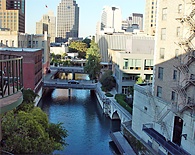
cities and towns in Bexar County include Alamo Heights, Balcones
Heights, Castle Hills, Converse, Lytle, Olmos Park, Terrell Hills,
Timberwood Park, Universal City, and Windcrest.
Other
cities and towns in Bexar County include Alamo Heights, Balcones
Heights, Castle Hills, Converse, Lytle, Olmos Park, Terrell Hills,
Timberwood Park, Universal City, and Windcrest.
One of the most visited attractions in Texas, the Alamo, is located in the heart of San Antonio. Also, while in Bexar County, have dinner at the Tower of the Americas. See La Villita, (Spanish for little town), the original settlement of Old San Antonio, comprises one block in downtown San Antonio. Six Flags Fiesta Texas is America's top show park.